The Best ABC Books for Preschoolers — What Parents and Educators Actually Recommend

Every parent of a preschooler has stood in front of a wall of alphabet books and felt, at some point, genuinely overwhelmed.
There are hundreds of them. Possibly thousands. ABC books with animals. ABC books with vehicles. ABC books with food, with sport, with nature, with characters from shows the child has already watched three hundred times. Books that sing, that light up, that have flaps to lift and textures to touch. Books shortlisted for awards and books recommended by educators and books that look beautiful on the shelf but get read exactly once before something else catches the child's attention.
And somehow, despite all of that choice, most children have one ABC book they truly love. The one they ask for by name. The one that gets worn at the corners from being opened so many times. The one the parents could recite from memory because it has lived in the bedtime rotation for months, possibly years.
The question worth understanding is what makes that book the one.
Because it is not always the most expensive. It is not always the most sophisticated. It is almost never the one that arrived with the most fanfare. It is the one that meant something — to the child, and to the adult reading it alongside them.
What makes an ABC book genuinely effective for preschoolers
An alphabet book is doing several things at once, whether the reader is aware of it or not.
At the most fundamental level, it is introducing letter recognition — showing a child what each letter looks like, giving it a name and beginning to associate it with a sound. But that is the floor of what a good ABC preschool book does, not the ceiling.
The most effective alphabet books go further. They build vocabulary by connecting each letter to a word the child will encounter in the world beyond the page. They develop phonemic awareness — the understanding that letters represent sounds, and that sounds combine into meaning — in a way that feels natural rather than instructional. They support early comprehension by placing words in a context the child can relate to and be curious about. And they do all of this while being genuinely enjoyable to read, because a book a child does not enjoy is a book that does not get opened a second time.
The book that achieves all of those things simultaneously is rarer than the volume of options suggests. Most ABC preschool books do one or two of them reasonably well.
The best ones do all of them — and they do something additional that the merely adequate ones miss entirely.
They give the child a reason to care about the letters.
Not because letters are intrinsically exciting to a three-year-old. Because the letters are pointing to something that already matters to them. A world they want to understand. A person they want to know better. A language that connects them to something real in their life.
That is what separates the ABC book that gets read once from the one that gets read forty times.
The problem with most alphabet books
Walk through the ABC section of any bookshop and the dominant design approach becomes apparent quickly. Most alphabet books follow a well-worn formula: one letter, one image, one word. A is for apple. B is for ball. C is for cat. The letters move in order, the words are common and simple, the illustrations are cheerful and accessible.
There is nothing wrong with this formula. It is clear, it is accessible and it functions as a basic letter-introduction tool for children who have no particular relationship to any of the content.
But it has a significant limitation that most parents discover only after they have bought a few of these books: the words are generic. The images are interchangeable. The book could belong to any child, read by any adult, in any household. And for a preschooler — a child who is fiercely interested in specific things, who has passionate opinions about what matters and what does not, who responds to the world of the people they love with an intensity that diminishes as they grow older — generic is the enemy of engagement.
A four-year-old who is indifferent to apples and cats but fascinated by everything their dad does — the tools, the fishing gear, the footy boots by the door, the uniform hanging in the hall — is not going to carry a standard ABC book to bedtime and ask for it again.
They will sit through it politely and wait for something else.
But give that child an alphabet book built around their dad's world and something different happens entirely. The letter becomes a door into a world they already want to understand. The word becomes part of a language they are actively trying to learn. The book becomes a bridge between the child's curiosity and the person they are most curious about.
How ABC books build early literacy — and why context is everything
The science of early literacy is clear on a point that most alphabet books quietly ignore: children learn language most effectively when new words and concepts are embedded in meaningful context.
This is not a subtle finding. It is one of the most consistent results in child development research, and it has direct implications for how alphabet books should be designed and chosen.
A child who encounters the word reel in an alphabet book about fishing — read by their dad, who picks up the book and says that's exactly what I use on the river, let me show you — is not just learning a word. They are learning it embedded in a context rich with meaning, personal relevance and emotional warmth. That word will stick in a way that the same word on a flashcard, or in a generic alphabet book with no connection to anyone's real life, never would.
The mechanism is straightforward. Memory forms strongest around emotionally significant experiences. A child who learns letters through a book that connects to their most significant relationship — with their father, through his world — is creating memory anchors that a neutral learning context cannot replicate.
Think about the words adults remember from their own childhoods — the ones that stayed. They are almost never the words from worksheets or drills. They are the words attached to experiences, to people, to moments that carried emotional weight. The word a grandparent used. The name of something encountered on a trip. The particular vocabulary of a place or a person that became part of the fabric of early memory.
That is how lasting vocabulary forms. Not through repetition alone, but through repetition embedded in meaning. And when an alphabet book places letters in a world a child already loves — particularly their father's world, the world of the person they most want to understand — the vocabulary it builds has that same quality of sticking. Of becoming genuinely owned rather than temporarily memorised.
This is why the best ABC preschool books are not primarily about the letters. The letters are the vehicle. What makes them stick is the world the letters point to — and when that world is one the child already has a profound emotional investment in, the literacy outcomes follow naturally and durably.
Letter recognition is one outcome. But the love of reading, the hunger for vocabulary, the understanding that books contain worlds worth exploring — those outcomes require a book the child genuinely wants to return to. And children return to the books that mean something to them.
Age-appropriate ABC books by stage
Not all preschoolers are at the same developmental stage, and the right ABC book shifts considerably across the one-to-six age range.
Ages one to two.
At this stage, the priority is exposure and association rather than mastery. A one-year-old is not learning letter names — they are building the foundational understanding that marks on a page carry meaning, that books are worth attending to and that sitting close with a parent while something interesting happens on the page is a pleasurable and worthwhile experience. Bold, simple illustrations. Minimal text. Durable pages that survive enthusiastic handling. The reading experience here is almost entirely social — the warmth, the closeness, the adult's voice — and the book's specific content matters less than the shared ritual it creates.
Ages two to three.
Vocabulary is expanding at a remarkable rate. Children at this age are absorbing new words continuously, and they are particularly receptive to words that connect to contexts they find exciting. An ABC book built around a world they love — dad's fishing, his farming, his firefighting — gives that expanding vocabulary somewhere specific and meaningful to go. The child who learns the word reel at two will use it in conversation at three. The child who learns the word apple at two is less likely to do the same, because apples are already part of their world and do not require a book.
Ages three to four.
Letter recognition is now genuinely possible. A three or four-year-old can begin to identify individual letters by shape, associate them with their names and start building the connections between letters and sounds that underpin phonics. The best ABC books for this age range have rhythm in their language — text that flows naturally when read aloud, that the child can start to predict with repetition — and content that sparks enough curiosity to motivate the re-read. At this age, the re-read is not laziness or limited interest. It is how learning happens.
Ages four to six.
The preschooler approaching school is ready for richer vocabulary, more complex concepts and books that build on a foundation already established. An alphabet book at this stage works best when it introduces genuinely new ideas — words and concepts from a world the child has not yet fully explored — while connecting those ideas to something personally meaningful. This is where a book about dad's world, read consistently across the preschool years, produces particularly strong results: the child at five or six is encountering the same words they first heard at three, but now with the capacity to understand them more deeply and ask questions the earlier readings could not have prompted.
What makes a preschooler want to read the same book twice
The re-read is the gold standard of children's books. A book that a child asks to hear again — and again, and again — is doing something that most books do not manage. It is creating genuine engagement rather than passive reception.
The books that earn the re-read share a common quality: they give the child something new each time. Not literally new content — the words on the page do not change — but new connections. A new detail noticed in an illustration that was passed over before. A new question prompted by a word that the child is now old enough to wonder about. A new memory of something they did with their dad that a page just reminded them of.
And they give the adult reading something to add each time too. The best ABC preschool books give dad a launching pad at every single page — a word, an image, a concept that connects to his own experience and invites him to say something that is not written there. Something from his memory, his story, his specific knowledge of the world the book is about.
Those additions are different every night. The book is the same. But what happens around it — the conversation, the story, the particular exchange between this dad and this child on this evening — is always new. That is the re-read. That is the book that ends up worn at the corners and read until the pages are soft.
How dad's world transforms an alphabet book
The children's book market has long understood that context matters. There are ABC books built around farms, oceans, cities, space, sport — each one trying to make letters feel relevant by placing them in a world children find interesting.
What most of those books have not done is place letters in a world that matters to the specific adult who will be reading the book most often.
When an ABC book is built around what dad loves — his actual passion, his career, his hobby, the domain where he is most himself — the reading experience transforms at a level that generic topic-based alphabet books cannot reach.
Dad is not performing a letter exercise. He is not reading about someone else's world and translating it into something manageable for a child. He is sharing his own world — in his child's language, through illustrations that make his world look extraordinary — and he brings to every page a genuine engagement that is immediately felt by the child beside him.
The child who is read to by a parent who is truly present — who is interested in what is on the page because it is genuinely his — absorbs the letters, the words and the world they represent at a completely different level than a child who is read to by a parent who is going through the motions.
That is the quiet mechanism behind the best ABC books for preschoolers. Not clever pedagogy. Not innovative design. A parent who is alive inside the reading, and a child who feels it.
The best ABC books for preschoolers in Australia
For Australian preschoolers, the considerations that apply to alphabet book selection globally have local specificity worth noting. The world the book reflects should feel familiar and culturally relevant — the vocabulary, the references, the context should belong to Australian life rather than being translated from another country's version of childhood.
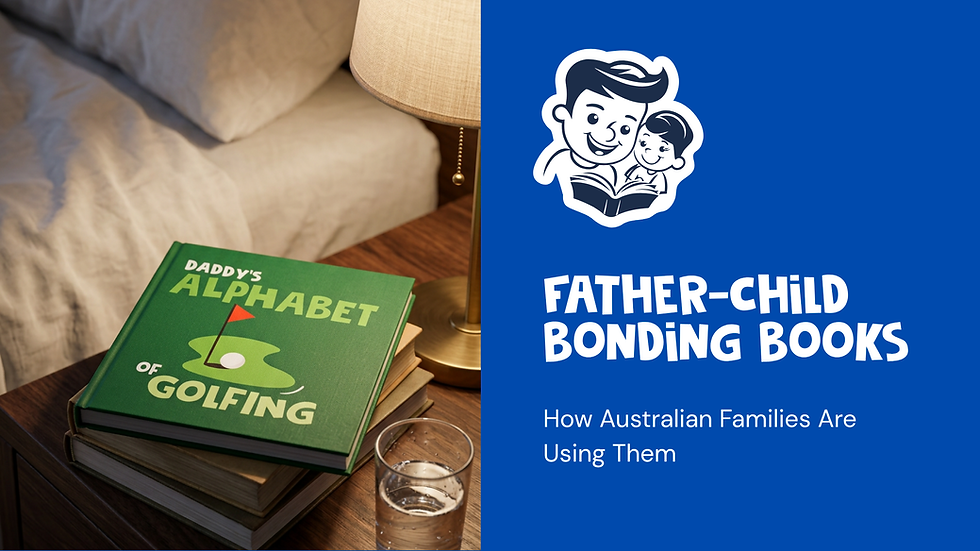
Daddy's Book Club was built in Australia, for Australian families, around exactly this idea. Every book in the collection reflects a specific dad's world — fishing, farming, footy, firefighting, tools, engineering, cooking, the outdoors and more — in language and illustrations designed for children from one to six, developed with the Australian context at the centre.
Each book is an alphabet book in structure. But it is an alphabet book that is simultaneously a conversation between a dad and his child — one that starts with A and continues long after the book is closed.
Every Letter. Every Dad. Every Child. Find His Book.
Daddy's Book Club is here for all types of dads.
Fishing dads, outdoor dads, footy dads, farming dads, first responder dads, tradie dads, foodie dads, military dads, car dads, fitness dads, creative dads — and every other kind of dad in between.
Browse the collection:
Daddy's Alphabet of Farming
Daddy's Alphabet of Firefighting
Daddy's Alphabet of Tools
Daddy's Alphabet of Space
Daddy's Alphabet of Cooking
Daddy's Alphabet of Motor Cars
(and more — with new titles added all the time)
If this resonated, you might also enjoy The Best Alphabet Books for Toddlers or How Daddy's Book Club Books Work.


Comments